A half-day route with a clear direction
Ciutat Vella makes more sense as a walk between different parts of the old town than as a collection of pins on a map. This route starts at the Central Market, continues to the Cathedral and finishes in El Carmen near the former Turia riverbed. Allow around four hours if you enter the Silk Exchange and take a break. Add the Cathedral and bell tower and it becomes the main activity of your day. These are suggested planning times, excluding queues.
There is a practical reason for starting at the market: it is a working shopping space and a morning visit suits it best. If you arrive in the afternoon or on a day without trading, change the order and concentrate on squares, façades and a chosen interior. Ciutat Vella is the historic district; El Carmen occupies only part of it.
Central Market and Silk Exchange: two sides of trade
Give the Central Market your first half-hour. Outside, notice the iron roof structure, ceramic details and weather vanes. Inside, look up at the dome before exploring fruit, vegetables, cured fish and charcuterie stalls. People come here to shop: leave the counter clear when a customer is being served and ask before photographing stallholders.
The Silk Exchange, directly opposite, deserves an interior visit. Its trading hall cannot be appreciated from the doorway. Walk among the twisting columns, follow the lines of the vaults and continue into the orange-tree courtyard. Allow roughly 40–50 minutes rather than treating it as a quick photograph. Between the two buildings, the market square also gives you a view of Santos Juanes church.
From Plaza Redonda to the Cathedral's three entrances
Continue past the Plaza Redonda area and Santa Catalina towards Plaza de la Reina. It is a short section, but shops, the church tower and little street junctions reward a slower pace. Horchata with fartons makes a useful break here; there is no need to commit to lunch before deciding which interior you want to see.
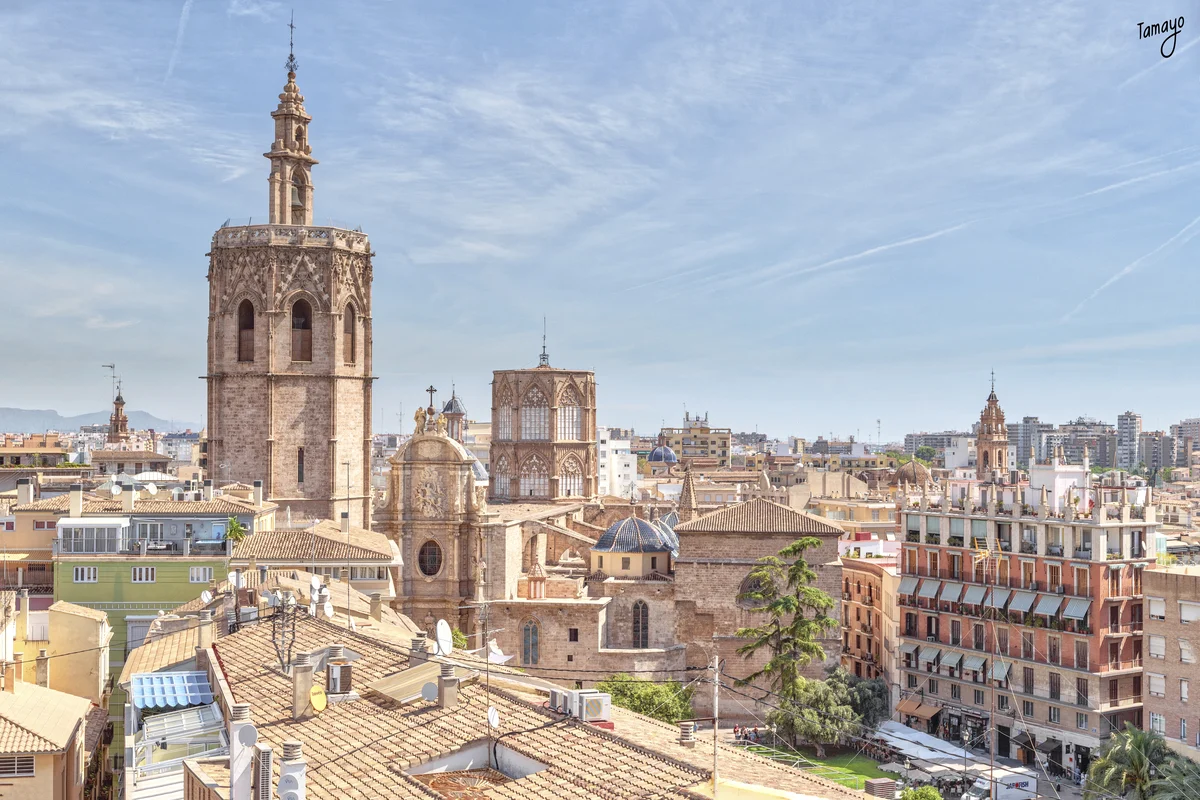
At the Cathedral, distinguish the cultural visit, the Holy Chalice chapel and the climb up the Miguelete, checking their respective access arrangements. You can also learn a lot without entering. Compare the baroque entrance facing Plaza de la Reina, the Gothic Apostles' Door towards Plaza de la Virgen and the Romanesque doorway on the Almoina side. Walking around the building tells you more than looking only at its main façade.
Plaza de la Virgen and El Carmen without backtracking
From Plaza de la Virgen, follow Caballeros towards El Tossal. Palaces, doorways and narrower streets replace the broad squares. To keep moving in one direction, continue along Serranos and Roteros towards the Serranos Towers, or make a longer loop through the Centre del Carme area before reaching the gardens. The Quart Towers stand on the other side of El Carmen: including both gateways means extending the walk.
This is a lived-in neighbourhood, with homes, schools and everyday shops among nightlife venues. Street art changes, so a particular mural need not become an essential stop. Explore side streets that lead somewhere, return to recognisable thoroughfares when necessary and do not enter residential hallways for photographs.
Where to eat and where to finish
If you reach El Carmen hungry, look for a table around El Tossal, Calle Alta or Roteros. Near the market, compare menus on the surrounding Mercat streets before choosing the first terrace. For a rice dish, ask how long it takes and whether a minimum number of servings applies. It is an awkward choice if you have a timed ticket forty minutes later. The food guide explains dishes and meal patterns.
Finishing at Serranos lets you descend into the Turia Garden and rest without retracing your route. The City of Arts and Sciences is too far away to count as a quick extra stroll: use transport or leave it for another day. The three-day plan distributes the old town, major attractions and seaside more comfortably.
Adjust the walk to your group
With children, choose one interior and use columns, gargoyles and gateways as things to spot; a long climb followed by another museum can exhaust the morning. If accessibility matters, check individual monument entrances before finalising the route: open squares do not make towers and bell towers accessible. For a shorter visit, keep Market–Silk Exchange–Cathedral and return to El Carmen another time. That leaves room to actually enjoy the places you choose.
Frequently asked questions
Where should I start with only one morning?
Start at the Central Market while trading is under way, then visit the Silk Exchange and Cathedral squares. Add El Carmen at the end if time allows.
Are Ciutat Vella and El Carmen the same place?
Ciutat Vella is the historic city district. El Carmen is one part of it, alongside areas such as El Mercat, La Seu and Sant Francesc.
Can I visit the Silk Exchange, Cathedral and Miguelete in four hours?
You can make those interiors the focus of a morning, but will need shorter market, café and El Carmen stops. Choose two main visits for a relaxed walk.
Are the Quart Towers next to the Serranos Towers?
No. They stand at different ends of El Carmen. Seeing both means crossing more of the neighbourhood and extending the route.
Where can I finish without returning to the market?
Leave through the Serranos Towers area and descend into the Turia Garden. Rest there or continue along a short section of the park.