Why visit a building devoted to trade?
The Silk Exchange shows that Valencia's historic wealth cannot be explained by churches and palaces alone. Commerce had its own architecture here, designed to lend authority to business. UNESCO placed the complex on the World Heritage List in 1996. The columns make an immediate impression, but connect the great hall with the courtyard and Sea Consulate: each space adds a purpose and changes the way you experience the building.
Allow roughly 45–60 minutes for an attentive visit without a guided activity. This is our planning estimate, not an official duration. Leave longer for sculpture and ceilings. The Central Market opposite makes a natural partner and closes earlier.
Start outside: step back to read the façade
Before approaching the entrance, stand on the Santos Juanes side of the square. Identify the broad body of the hall, the tower and the Consulate building. At the top of the latter, arches and Renaissance-style portrait medallions form a different decorative language. You can distinguish them more easily from a distance than in a photograph taken immediately below.
Then look more closely at doorways and exterior carvings. Gargoyles and figures offer more than a single decorative theme: compare them and notice how a solemn building can contain humour and surprising scenes. You do not need an unverified legend for every carving to appreciate that contrast.
The Trading Hall: follow a column to the vault
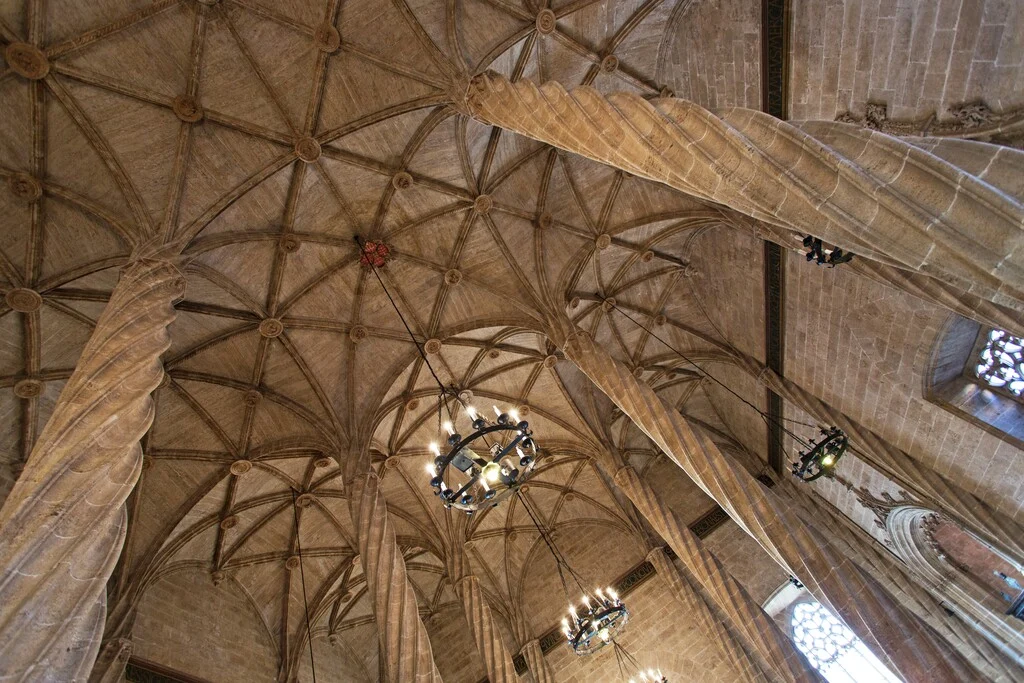
In the Trading Hall, start from one side and follow a spiral column upwards into the roof ribs. Then move towards the centre: the columns align differently and their repetition reveals the room's scale. Approach a window to see how daylight enters, then look back at the vaults. This small change of position helps you appreciate the construction.
Find the band of Latin inscription around the walls: its message links trade with honesty. It helps explain the hall's solemn scale. Exchanges depended on trust and public standing in a city connected with the Mediterranean. Inscription, columns and large windows together show how the building made that idea visible.
Courtyard and Sea Consulate: a change of pace
The Orange Tree Courtyard moves you from the hall's vertical impact into open space. Use it to understand how the different buildings connect, as well as pausing for a photograph. The Consulate introduces another scale and decorative scheme. If the upper room is accessible, allow time to look carefully at its timber ceiling.
The ceiling associated with the Golden Hall came from the former City Hall and was installed here in the twentieth century. In 2026 the council announced preparatory studies for its restoration. That does not establish a closure or a works timetable. Check access notices before visiting, and avoid making the appeal of the whole monument depend on a single room.
Do not assume the tower is part of every visit
Tower access can depend on specific tours, capacity and advance booking. Entering the Silk Exchange is not confirmation of a tower activity. If it matters to you, check the current council arrangements, particularly language, stairs and meeting place. For accessibility, ask about the actual route: a ramp at the entrance does not mean every floor is reached in the same way.
A well-ordered morning around the market square
Visit the market first while trading is active, then the Silk Exchange, leaving Santos Juanes or a walk towards Velluters for afterwards. In Velluters, the Colegio del Arte Mayor de la Seda distinguishes the place where deals were negotiated from the crafts and looms that produced cloth. It is a separate museum, without an automatic combined ticket.
For squares and churches, continue via Plaza Redonda and Santa Catalina towards the Cathedral. The Velluters branch instead develops the silk story. Choose what sparked your curiosity in the Exchange; the two-day plan leaves the other area for a different day.
Frequently asked questions
Is the Silk Exchange a church?
No. It is a civic complex connected with trade. The large Trading Hall explains its commercial purpose.
What should I see besides the columns?
The Consulate façade and medallions, carved entrances and gargoyles, the Orange Tree Courtyard and the Consulate ceiling when accessible.
Does general admission include climbing the tower?
Do not assume so. Tower access may be a separate activity with booking and capacity limits; check the council's current arrangements.
How long should I spend here?
Our estimate is 45–60 minutes without a guided activity, longer if you want to study the decoration and ceilings.
Is it the same as the Silk Museum?
No. The museum and silk guild college in Velluters focus on craft and production; the Exchange tells the trading story.
Should I visit the market or Exchange first?
Start with the Central Market if you want shopping and working stalls, because its regular closing time is earlier, then continue to the Exchange.